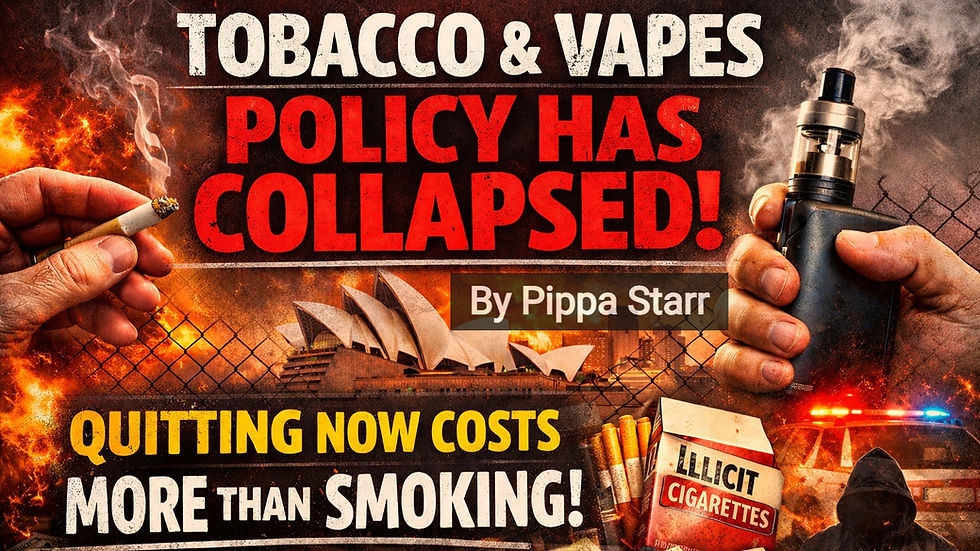
Australia’s Vaping Prohibition: One Year On, the Harm Is No Longer Theoretical


By Alan Gor 31 December 2025
Australia’s vaping prohibition is no longer a policy experiment conducted in anticipation of future outcomes. It is a lived national intervention, operating in real time, on real people. After one full year, its consequences are neither speculative nor unclear. They are visible, measurable, and increasingly difficult to deny.
This policy was sold to the public as decisive public health action: protect children, eliminate vaping, and accelerate the long-term decline of smoking. Instead, it has exposed a deeper failure of evidence-based policymaking, of ethical public health practice, and of institutional honesty.
What follows is not alarmism.
It is an accounting of cause and effect.
Prohibition Was a Choice, Not an Accident
Australia did not merely “strengthen regulation” of vaping products. It made a conscious, deliberate shift to prohibition.
Rather than regulate product standards, license retailers, enforce age restrictions, and integrate vaping into a coherent tobacco harm reduction framework, the government chose to eliminate legal consumer access. Retail supply was dismantled. Importation was criminalised. Regulatory oversight was abandoned.
This was not done because the regulation was infeasible. Other countries regulate vaping successfully. This was done because abstinence-only ideology became politically dominant within Australian tobacco control.
In doing so, policymakers knowingly removed the most effective smoking substitute available to adults who cannot quit nicotine entirely. They did so with full awareness of decades of harm reduction research showing that removal of safer alternatives does not eliminate demand—it increases risk.
That decision carries responsibility.
And responsibility does not expire with good intentions.
The Central Policy Failure: Ending Vaping Without Ending Smoking
The foundational contradiction at the heart of Australia’s vaping prohibition is this: nicotine dependence does not disappear when access to safer alternatives does.
For many smokers and former smokers, vaping was not a preference or a convenience. It was a stabilising intervention. It reduced cravings, controlled withdrawal, and prevented relapse. For these people, abstinence was not a realistic or immediate outcome, but harm reduction was.
Removing vaping did not move these individuals closer to nicotine-free lives. It placed them under pressure.
That pressure has been relieved in predictable, well-documented ways:
Some returned to smoking combustible cigarettes
Others turned to an unregulated, illicit supply
Many now live with heightened anxiety, instability, and constant relapse risk
These outcomes were not unforeseen. They are described repeatedly in harm reduction literature across drugs, alcohol, and tobacco. When safer substitutes are removed without eliminating demand, harm increases.
The resulting harm was not accidental.
It was an accepted cost.
The Evidence Problem: When Data Refused to Cooperate
Throughout the year, population-level data repeatedly failed to align with the official narrative of success. Rather than prompting a transparent review, this misalignment was managed through framing.
Smoking Reappeared Where It Was Supposed to Disappear
Roy Morgan data showed increases in smoking, particularly among young adults, following tighter vaping restrictions. This was not a marginal statistical anomaly. It occurred in the very cohort that vaping restrictions were supposed to protect.
These findings did not trigger emergency reassessment. They were not foregrounded in public communication. Instead, subsequent statements softened language, shifted emphasis, and reduced visibility without any meaningful improvement in the underlying outcomes.
This was not statistical uncertainty.
It was reputational damage control.
Lagging Data Used to Justify Leading Claims
At the same time, AIHW datasets largely reflective of pre-ban conditions, continued to be cited as evidence of policy success. Data collected before prohibition was used to defend outcomes after prohibition.
This created a false sense of confidence: policy conclusions racing ahead of the evidence capable of testing them.
In evidence-based public health, data are supposed to challenge policy assumptions. Here, it was used to shield them.
“Generation Vape”: When Youth Protection Becomes Policy Theatre
The Generation Vape report became the moral and political centrepiece of vaping prohibition.
Its framing was absolutist: youth vaping as an existential public health emergency demanding eradication. But in elevating this narrative, crucial context disappeared:
Youth smoking trends were sidelined or omitted
Substitution effects between vaping and smoking were ignored
Correlation was selectively treated as causation
Contradictory population-level data were dismissed
Media coverage largely repeated the report’s conclusions without scrutiny, amplifying fear rather than analysis.
Protecting young people from nicotine addiction matters.
But protecting youth does not require ignoring adult harm, nor does it justify policies that risk increasing smoking.
When youth protection becomes a rhetorical shield against accountability, it ceases to be public health and becomes policy theatre.
Academic Authority Without Accountability
Throughout the year, academic studies were promoted as confirmation that vaping undermines tobacco control. These studies were often presented as definitive, rather than tentative or contested.
On closer inspection, many relied on fragile assumptions:
Statistical models that masked cohort, age, and gender differences
Time-series analyses are insensitive to abrupt policy shocks
Attitudinal surveys substituted for real-world behaviour
Smoking outcomes are treated as secondary to theoretical concerns
These studies were not fabricated. But they were not strong enough to justify the certainty with which prohibition was imposed.
Science does not progress through unanimity.
It progresses through challenge, contradiction, and correction.
When dissenting evidence is excluded, science becomes dogma.
The Illicit Market: Not a Side Effect, but a Structural Outcome
Prohibition did not eliminate vaping. It eliminated regulation.
Unregulated disposable vapes became easier to obtain, not harder. Age verification deteriorated. Product standards vanished. Criminal supply networks replaced licensed retailers, subject to oversight and accountability.
For adults attempting to remain smoke-free, the choice became stark: return to cigarettes or purchase illegal products.
This outcome is not surprising. It is not anomalous. It is exactly what prohibition produces when demand remains.
This is not an enforcement failure.
It is functioning as designed.
The Harm No One Measures: Psychological and Human Cost
Perhaps the most telling omission in official assessments is the near-total absence of mental health impact.
For people using vaping to remain smoke-free, prohibition has produced:
Chronic stress about access
Persistent fear of relapse
Stigma and criminalisation
A sense of disposability within public health priorities
For those with existing mental health challenges, including veterans and long-term smoker this instability is not incidental. It compounds vulnerability.
Public health that refuses to measure psychological harm is not neutral.
It is selectively blind.
Population-Level Harm Has Become an Accepted Tool
By the end of the year, a disturbing ethical logic had become entrenched:
If some people return to smoking, that is unfortunate.
If anxiety and distress increase, that is tolerable.
If illicit markets flourish, that is someone else’s problem.
This logic represents a profound departure from harm reduction principles. It reframes preventable suffering as acceptable collateral in the pursuit of ideological purity.
Harm reduction exists precisely to reject this calculus.
Global Narratives, Domestic Consequences
Australia’s approach mirrors a broader international shift. WHO campaigns increasingly target vaping while combustible cigarettes recede from view. Institutional and philanthropic messaging reinforces abstinence-only frameworks.
What appears to be a global consensus is, in reality, a convergence of institutional interests, not evidence.
Australia chose alignment over evaluation.
Responsibility Can No Longer Be Deferred
After one full year, policymakers can no longer claim uncertainty or caution.
They were warned.
The data signalled risk.
The illicit market was inevitable.
The human cost was predictable.
Continuing this policy without transparent reassessment is no longer prudent.
It is negligence.
A Line That Cannot Be Crossed Again
Harm reduction is not about promoting nicotine.
It is not about denying risk.
It is about reducing death, disease, and suffering in the world as it exists, not as ideology wishes it to be.
Australia’s vaping prohibition has failed that test.
Public health must answer not only for what it intends, but for what it causes. After one year, the harm is no longer invisible.
It is simply being ignored.