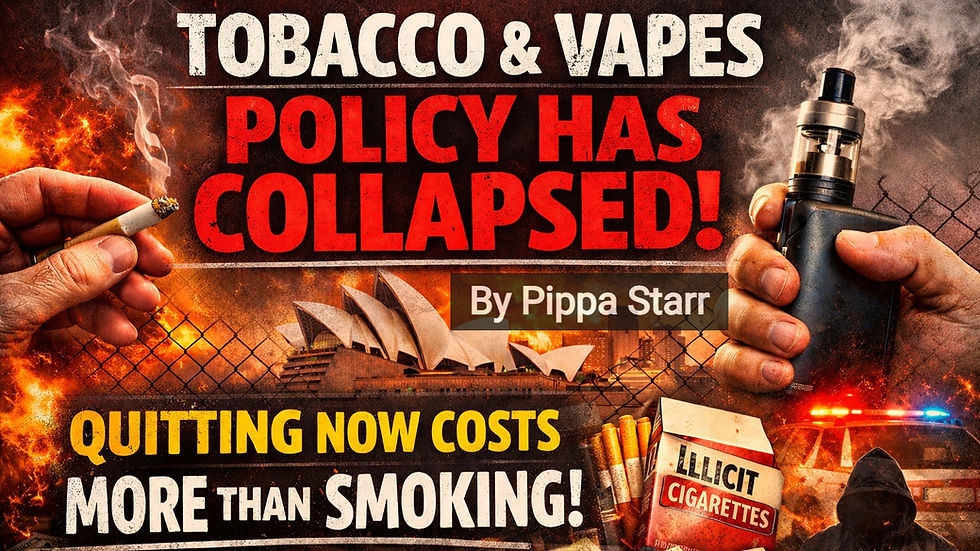
The ITEC (Illicit Tobacco and Vapes Commissioner) Report 2024–25: A Glass-Half-Empty Defence of a Broken System


By Alan Gor 11 December 2025
The ITEC Commissioner Report 2024–25 has landed, immediately heralded as a triumph of coordination, enforcement, disruption, and government resolve.
But strip away the press-friendly language, and you are left with something far less impressive.
The report is essentially a logbook of raids, seizures, counterfeit busts, “disruptions,” forced closures and operational wins. It documents the smoke, not the fire. The activity, not the impact. And crucially, it avoids the one question that matters:
Why does illicit tobacco exist on such a massive scale in Australia at all?
The report does not address that question because the answer exposes the fatal flaws of Australia’s current tobacco and nicotine policy architecture.
Once you acknowledge those failures, the entire prohibition-first enforcement model collapses.
What follows is the uncomfortable truth the report tiptoes around, and the government refuses to confront.
1. It Treats Symptoms, Not Causes
The ITEC Report reads more like an annual crime blotter than a public-health strategy.
It features endless counts of:
• raids
• seizures
• kilograms of chop-chop
• counterfeit packets
• haul numbers
• arrests
• “disruptions”
But this is busywork, not progress.
Australia’s illicit tobacco market is not a policing failure; it is an economic failure.
We have:
• the world’s highest tobacco taxes
• a punitive ban on consumer nicotine alternatives
• a regulatory system that treats nicotine as contraband
This combination creates the perfect storm:
extremely high demand + severely restricted legal supply = inevitable, massive illicit market.
ITEC has become the firefighter endlessly spraying water, while the government keeps throwing petrol on the blaze.
2. It Reinforces Prohibition, And Prohibition Always Backfires
The report’s worldview is abundantly clear:
“Illicit tobacco exists because criminals sell it. Therefore, crack down harder.”
This thinking is policy malpractice.
When legal supply is restricted or banned, demand does not disappear; it simply flows into the path of least resistance.
In Australia’s case:
Disadvantaged smokers relapse because legal products are unaffordable.
Adults wanting to quit or switch are locked out of safer alternatives.
Consumers turn to unregulated vapes or chop-chop.
Criminal syndicates scale up industrial operations to meet demand.
Violence, coercion and money-laundering flourish around the margins.
This is not a criminal problem with a health dimension.
It is a health-policy failure with criminal consequences.
The government created conditions where organised crime became the default supplier.
3. It Provides Political Cover, Not Public-Health Reform
This may be the report’s most insidious function.
ITEC gives the government an alibi:
“Don’t worry, we’re cracking down. We’re on top of this. Everything under control.”
This narrative allows the government to avoid accountability for the policy drivers behind the illicit market:
• extreme excise hikes that pushed prices beyond affordability
• bans on vaping and nicotine products that created unmet demand
• refusal to regulate safer alternatives
• prohibition-era instincts masquerading as public health
• a surrender to ideology over evidence
ITEC’s enforcement-heavy framing acts as a shield to protect the government from the consequences of its own choices.
Instead of reform, we get theatrics.
4. It Deepens Inequity and Punishes the Most Vulnerable
Who suffers most under Australia’s current system?
Not policymakers.
Not academics.
Not advocacy groups.
Not the comfortable middle class.
It is low-income Australians, the same communities with the highest smoking rates and the least access to cessation tools.
Legal cigarettes are unaffordable.
Safer nicotine alternatives are criminalised.
Medicalised access is a bureaucratic obstacle course.
So these communities turn to illicit suppliers.
They pay inflated cash prices to organised crime.
They are exposed to unsafe, unregulated products.
They become the focus of punitive policing measures.
Meanwhile, health inequality widens and trust in institutions collapses.
The report does not mention any of this.
It pretends the market is driven by opportunistic criminals, not desperate consumers shut out of a functioning legal system.
5. It Pretends Harm Reduction Doesn’t Exist
The most telling omission in the entire report is what it refuses to discuss.
There is no acknowledgment of:
• tobacco harm reduction
• nicotine substitution
• regulated alternatives
• differential risk
• international evidence from successful countries
The worldview embedded in the report is blunt and binary:
nicotine = danger
users = offenders
harm reduction = taboo
alternatives = irrelevant
This is not science.
It is ideology dressed as enforcement.
Countries that have slashed smoking rates Sweden, the UK, New Zealand, and the US, did so by giving adult smokers safer options, not criminalising them.
Australia is now the global outlier.
Our illicit market is not an anomaly; it is the predictable result of refusing to modernise nicotine policy.
6. It Protects the Smoking-Only Market Structure
Perhaps the darkest irony of the ITEC enforcement model is this:
By banning low-risk products and only allowing the sale of combustible cigarettes, the government protects the most dangerous nicotine product ever created.
Every seizure and raid helps reinforce the status quo:
• Smoking is legal
• Safer alternatives are not
• Regulated competition is outlawed
• The legacy tobacco industry remains the only legal supplier
This is not public health.
This is regulatory capture hiding behind moral rhetoric.
The government isn’t fighting organised crime; it is indirectly supporting the monopoly of combustible tobacco.
7. It Strengthens Organised Crime, Not Public Health
The ITEC Report proudly lists “disruptions” and “dismantled supply chains.”
But disruption is not dismantling.
Supply is not decreasing; it’s shifting.
Criminal networks are not shrinking; they’re adapting.
Each enforcement wave triggers:
• higher prices
• more risk premiums
• more violence
• more sophisticated networks
• more corruption opportunities
• deeper entrenchment
We’ve seen this script before:
alcohol prohibition, the war on drugs, and street-level opioid policing.
None of it worked.
None of it ever will.
You cannot criminalise the laws of supply and demand.
Until Australia regulates safer alternatives and realigns pricing incentives, illicit operators will continue to flourish.
8. It Undermines Trust, Transparency, and Data Integrity
Australia now has a parallel nicotine economy of staggering size.
This disrupts:
• ABS modelling
• Treasury revenue forecasts
• excise reliability
• national smoking estimates
• disease burden calculations
• hospital cost projections
If half the country’s nicotine consumption is off the books, then public-health planning becomes speculative fiction.
Yet the report avoids grappling with this reality because doing so would force a reckoning:
The illicit market is not rogue activity; it is the system functioning as designed.