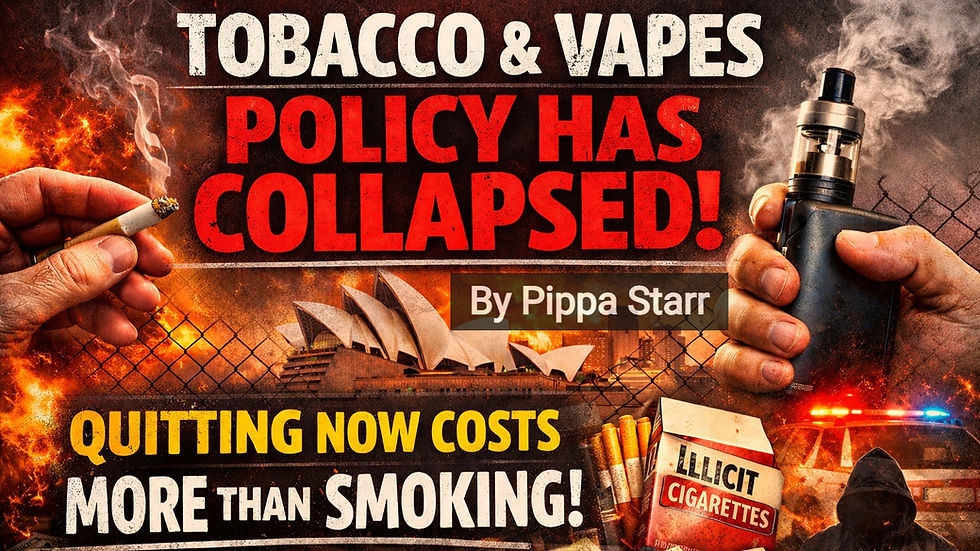
Tobacco & Vapes Policy Has Collapsed! Quitting Now Costs More Than Smoking!

There is something profoundly broken about a public health system in which trying to quit smoking costs more than continuing to smoke, if you buy illicit cigarettes.
But over 80% of the nicotine consumer market now buy illicit suppliers.
That is now the reality in Australia.
For years, governments have justified relentless tobacco tax hikes as a necessary public health measure. Make cigarettes expensive, they said, and smokers will quit. What actually happened was entirely predictable, and entirely ignored. Policy settings became so distorted that the cheapest nicotine in Australia is often illegal cigarettes, while officially endorsed quitting tools remain comparatively expensive.
"That is not tobacco control. It is economic coercion without a workable exit."
The price signal is upside down!
In theory, nicotine replacement therapy (NRT) is meant to be the off-ramp from smoking.
In practice, it has become another financial hurdle.
A smoker attempting to quit using patches, gum, or lozenges can easily spend $40–$60 per box, often needing multiple products at once to manage cravings. Over weeks or months, the cost can exceed what the same smoker would spend on cheap illicit cigarettes.
Meanwhile, the black market flourishes, offering packs at prices legal retailers can’t match and pharmacies can’t compete with.
The public health logic has inverted:
The most dangerous option is cheaper
The safer option costs more or is banned
The policy response is based on ideology and denial
"If quitting is meant to be the rational choice, government policy has made it financially irrational for millions."
This isn’t about willpower, it’s about design failure!
Smoking cessation policy continues to lean on moral framing: smokers must want to quit badly enough. But addiction does not respond to lectures, and it certainly does not respond to price punishment alone.
Many smokers live week-to-week. Many are holding on by a thread in a cost of living crisis, dealing with housing stress, chronic illness, or mental health conditions. For them, the decision is brutally simple: what can I afford right now?
When quitting costs more than continuing, policy has already failed.
At that point, illicit tobacco isn’t a “choice”. It is the predictable outcome of economic pressure applied without a viable alternative.
Regulated adult vaping is the missing piece
There is a solution sitting in plain sight, supported by decades of international evidence and basic economic logic: sensibly regulated adult access to vaping products.
Vaping is not a theoretical harm-reduction tool. It is already the most effective consumer-driven alternative smokers have ever had. Where adults can legally buy regulated vaping products:
smoking rates fall faster
quit success improves
black-market tobacco loses customers
This is not controversial outside Australia.
A legal, regulated retail vaping market does three things NRT alone cannot:
Competes on price with illicit cigarettes
Competes on satisfaction, replacing smoking rather than merely suppressing cravings
Keeps consumers inside a regulated system, not criminal supply chains
By contrast, over-restricting or prohibiting legal vape retail access doesn’t eliminate demand, it simply hands that demand to criminals.
Australia has chosen the worst of all worlds: extreme cigarette prices, expensive cessation tools, and tight restrictions on the one product category that actually pulls smokers away from combustion.
"You cannot ban your way out of demand"
Harm reduction exists because people do not quit on command. It acknowledges human behaviour rather than trying to punish it into submission.
But Australian policy has drifted into moral absolutism: smoking must end, nicotine must be tightly controlled, and price pressure must do the rest.
The result has been entirely predictable:
smoking persists
illicit markets expand
enforcement costs explode
Public health officials denounce the consequences while refusing to change the settings that produce them.
The question policymakers keep dodging
If the genuine goal is reducing smoking-related harm, this question cannot be avoided:
Why does Australia make it cheaper to buy illegal cigarettes than to access effective, lower-risk alternatives?
Until quitting is easier, cheaper, and more accessible than continuing, especially for low-income smokers, tobacco control rhetoric will remain hollow.
This is not about being “soft” on smoking. It is about designing policy that works in the real world.
The kicker policymakers don’t want printed
Every smoker priced into the black market becomes an unwitting customer of organised crime. Every illicit pack sold strengthens criminal networks, fuels violence, and drives up costs for police, customs, fire services, courts, and insurers.
Australia is now spending hundreds of millions, likely billions, cleaning up the downstream consequences of policies that made illegal cigarettes economically attractive while blocking legal harm-reduction alternatives.
This is not an enforcement failure. It is a policy failure, fully foreseeable and entirely self-inflicted.
Regulating adult vaping with sensible legal retail access would not just save lives. It would assist the collapse of the illicit tobacco market by undercutting it, returning consumers to regulated channels and cutting organised crime off at the source.
Until governments are prepared to accept that reality, Australians will keep paying for it in their taxes, at the checkout, in emergency responses, and in preventable disease, for a system that punished smokers without giving them a realistic way out!