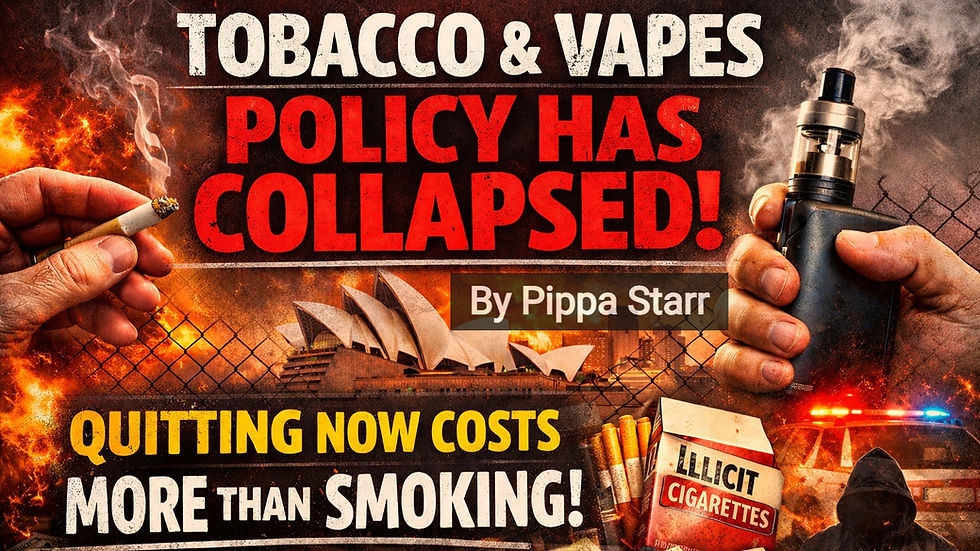
When Canberra Holds an Inquiry Into a Crisis It Helped Create, But Leaves the Consumers Outside the Room!

by Pippa Starr
5 May 2026

Yesterday, something extraordinary happened in Canberra.
At the Senate inquiry into Australia’s illegal tobacco crisis, the government’s own Illicit Tobacco Commissioner, admitted what many Australians already know:
“Illicit trade now dominates the Australian market.”
Read that again.
Not “is growing. ”Not “is concerning. ”Not “is becoming a problem.”
Dominates.
That is an extraordinary admission.
It means the black market is now bigger than the legal market.
After decades of tobacco control, billions in enforcement, endless tax hikes, and now some of the harshest vaping restrictions in the democratic world, Australia has handed organised crime the keys to nicotine supply.
And yet, in a hearing about the illegal tobacco crisis, one voice was glaringly absent:
Consumers.
The people actually buying nicotine.
The people who quit smoking through vaping.
The people navigating the black market policymakers created.
The people living in the suburbs where tobacconists are being firebombed.
I know this because I offered to appear.
My submission to the inquiry, the second accepted submission, was one of the earliest consumer-based warnings to the committee, grounded in direct engagement with over 1,000 Australian consumers through the ALIVE Advocacy Movement. It specifically offered evidence in person.
But no invitation came.
That matters.
Because when you build policy without the people living under it, you get fantasy.
And fantasy is exactly what Australia’s nicotine policy has become.
The Firebombing Ledger Nobody Can Ignore
For over two years, I’ve been documenting the fallout.
Not theory.
Not modelling.
Reality.
At ALIVE, we’ve tracked 285 firebombings, arson attacks and violent incidents linked to the illicit tobacco and vape trade.
That tally has become, quietly, one of the most relied-upon resources by journalists, politicians and insiders inside Parliament of Australia.
People in Canberra know it.
They reference it.
They watch it grow.
And still, many pretend the cause is unclear.
It isn’t.
When you ban or over-restrict a product millions still want, the market does not disappear.
It relocates.
Fast.
And violently.
The Same Architects of Failure Keep Returning to the Table
One of the strangest parts of this inquiry is who keeps getting the microphone.
The same policy class.
The same institutional voices.
The same lobby ecosystem.
Cancer Council Australia.
Lung Foundation Australia.
Australian Council on Smoking and Health.
These organisations helped advocate for the very settings that helped produce this mess.
Now they’re being consulted on how to fix it.
That’s like asking the arson investigator to consult the bloke holding the jerry can.
If your policy created a criminal market larger than the legal one, at some point intellectual honesty requires asking:
What if the policy itself is the problem?
The Harm Reduction Blind Spot
What was most striking in this inquiry wasn’t just what was said.
It was what wasn’t.
Tobacco harm reduction, the single most important missing pillar of Australian nicotine policy, was barely acknowledged.
A few important mentions from James Martin stood out.
But beyond that?
Silence.
That silence is dangerous.
Because the world has already run this experiment.
Look at New Zealand.
They embraced regulated vaping.
Smoking rates collapsed.
Look at Sweden.
Through safer nicotine alternatives like snus and vaping, they are on the verge of becoming the first smoke-free country in Europe.
Not by prohibition.
By substitution.
Australia chose the opposite path.
And now organised crime is thriving because of it.
We Have Run Out of Comfortable Options
There comes a point where ideology collides with reality.
We are there.
If over 60% of tobacco consumed is now illicit, as discussed in the hearing, then the excise model is no longer functioning as intended.
At that point, cutting tobacco excise is no longer surrender.
It is triage.
Painful?
Yes.
Politically ugly?
Absolutely.
But necessary.
Because if legal tobacco remains absurdly expensive while illicit tobacco remains cheap and everywhere, the criminal market will keep winning.
That is economics.
Not ideology.
And the Vape Bans? They Poured Petrol on the Fire
This part matters.
Before the crackdown, Australia had legal adult-only vape stores.
Age-gated.
Transparent.
Accountable.
Taxable.
Then government shut much of that system down.
What replaced it?
Not abstinence.
Not reduced demand.
The black market.
Again.
When you close legitimate supply but leave demand untouched, criminals step in.
Every time.
Rolling back the vape bans is not “going soft.”
It is reclaiming the market.
But it must be done sensibly:
adult-only retail
strict ID enforcement
product standards
sensible nicotine access
truthful public health communication
Not fear campaigns.
Not moral panic.
Truth.
Because if Australia continues telling smokers that vaping is basically the same as smoking, many will simply keep smoking.
And some will buy both from criminals.
This Isn’t a Law Enforcement Failure.
It’s a Policy Failure!
That’s the uncomfortable truth.
More raids won’t fix this.
More seizures won’t fix this.
More police won’t fix this.
Even Senator Richard Colbeck made the obvious point:
"If seizures are increasing but the market is growing faster, we are going backwards."
That’s the whole story.
Australia’s illegal tobacco crisis is not an enforcement problem.
It is a prohibition problem.
And until Canberra is willing to hear from the consumers who warned this would happen, not just the policy insiders who helped create it, the firebombing tally will keep climbing.
And so will the body count from smoking.
At some point, you stop doubling down.
At some point, you change course.
Australia has reached that point.
The full inquiry: https://www.youtube.com/watch?v=6SFB7wvb5SM